
On 7 July 2026 the IRD opened its e-Services portal for Year of Assessment 2025/26 returns — individual, corporate and partnership, including a simplified individual option. The return is due on or before 30 November 2026. So the window is open right now, and it is about four months wide.
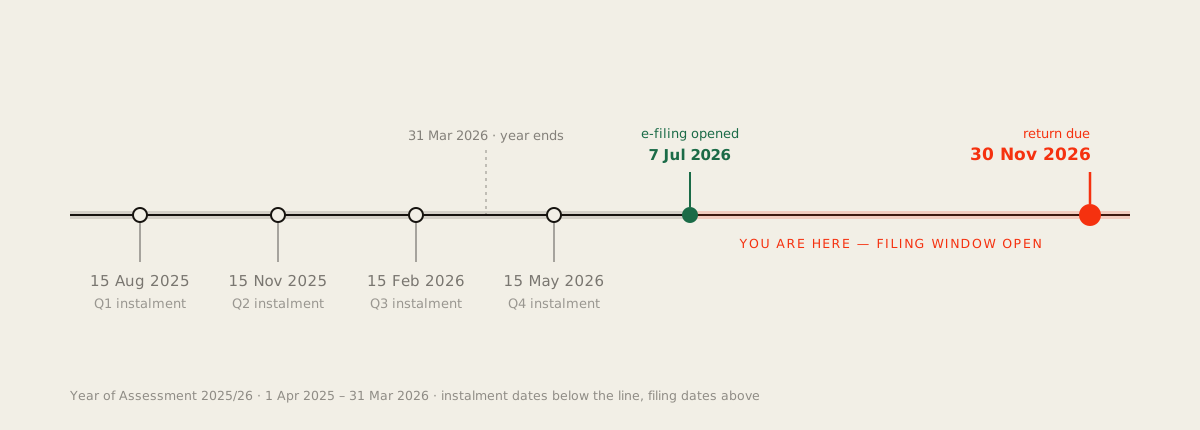
Look at the left half of that timeline, because it is the part that catches people. Four instalment deadlines have already gone, the last of them on 15 May 2026. If you owed quarterly instalments and didn't pay them, November isn't your first missed date — it's your fifth, and interest has been running on the earlier ones since the day each fell due.
This guide lays out every date, what each requires, and what being late actually costs in rupees. It's general information, not personalised tax advice, so cross-check against the IRD's own site or a qualified advisor before you act.
The two kinds of deadline
Sri Lanka's individual income tax system runs on two separate tracks, and it's easy to confuse them:
- Quarterly instalments (SET): if you pay tax by self-assessment (freelancers, landlords, anyone without full APIT withholding), you estimate and pay tax four times during the year via a Statement of Estimated Tax Payable.
- The annual return: everyone required to file submits one Return of Income after the year ends, reconciling what was actually paid (APIT, AIT, SET instalments) against what was actually owed.
You can owe nothing on the annual return and still face penalties for a late quarterly instalment, or file instalments perfectly and still be penalised for filing the annual return late. They're independent obligations.
YA 2025/26 quarterly instalment (SET) deadlines
| Quarter | Period covered | Payment due |
|---|---|---|
| Q1 | April – June 2025 | 15 August 2025 |
| Q2 | July – September 2025 | 15 November 2025 |
| Q3 | October – December 2025 | 15 February 2026 |
| Q4 | January – March 2026 | 15 May 2026 |
Source: Sri Lanka Tax Agency Announces Filing, Payment Deadline for 2025-2026 Statement of Estimated Tax Payable, Bloomberg Tax; Taxable.lk, "Why May 15, 2026 Matters for Sri Lankan Taxpayers".
If today's date is past May 2026, all four YA 2025/26 instalments have already fallen due, and what's left is the annual return below.
The annual return deadline: 30 November 2026
The Return of Income for YA 2025/2026 is due on or before 30 November 2026, under Section 93 of the Inland Revenue Act. Filing is done exclusively through the IRD's e-Services portal. Paper returns for individuals are no longer accepted, since electronic filing is mandatory under section 113(1B) of the Inland Revenue Act No. 24 of 2017.
The IRD has publicly urged taxpayers not to leave it to the last week, warning that portal traffic spikes and technical issues cluster right before the deadline. (Source: IRD Opens Online Tax Return Filing for 2025/2026 Assessment Year, Lanka News Web.)
Don't wait until the last week of November. The final days before any IRD deadline are when the e-Services portal is slowest and most likely to time out.
What it costs to be late
The IRD's penalty structure is more specific than most people expect: it isn't a flat fine.
| Situation | Penalty |
|---|---|
| Instalment paid within 14 days of the due date | No penalty, but interest still accrues from the original due date |
| Instalment paid more than 14 days late | A 10% penalty on the unpaid amount (Section 179(2)) |
| Any late or unpaid tax, ongoing | Interest at roughly 1.5% per month (Sections 157 and 159(1)), calculated from the original due date, not the end of the grace period |
| Annual return filed after 30 November 2026 | A separate penalty under Section 93, independent of any instalment penalties |
Source: Taxable.lk, "Why May 15, 2026 Matters for Sri Lankan Taxpayers".
To make that concrete: a missed instalment of LKR 500,000, paid six months late, costs roughly LKR 595,000 — the 10% penalty adds 50,000, and interest at about 1.5% a month over six months adds about 45,000. That is nearly LKR 95,000 for being six months late on a single quarter, before the separate late-filing penalty on the annual return.
What you need before you file
Gather these before you open the e-Services portal, not after:
- Your Taxpayer Identification Number (TIN) and e-Services login
- APIT/PAYE certificates from every employer you had during the year
- Withholding tax certificates for interest, dividends, or rent (AIT)
- Records of any foreign-currency income and tax already paid overseas
- Proof of qualifying payments (donations, solar installation costs, and similar reliefs)
- Business income and expense records, if you're self-employed or freelancing
Source: TaxWise.lk, "How to File Your Income Tax Return in Sri Lanka: 2025/2026 Step-by-Step Guide".
Why this catches people every year
Two patterns come up constantly. First, people who moved from a single employer to freelance or mixed income mid-year don't realise they've crossed into self-assessment territory, and miss their first SET instalment entirely. Second, people conflate the SET deadlines with the annual return deadline and assume November covers everything, but it doesn't; the instalments were due months earlier, on their own schedule.
What to do in the next four months
Filing is open, so the useful move is to find out what you owe now rather than in the last week of November when the portal is at its slowest.
That means getting to a number you trust. Salli computes your YA 2025/26 position from your posted ledger — reliefs, bands, and APIT/AIT credits included — flags income that should have triggered a quarterly instalment, and shows the working so you can check every line. The tax figures come from a deterministic engine, not a language model; here is why that distinction matters.
If your income comes from overseas clients, read the 15% foreign-income rule first — the breakeven in that article decides which route you should be filing under. If you want the portal walkthrough, see the RAMIS step-by-step.
Sources
- IRD Opens Online Tax Return Filing for 2025/2026 Assessment Year, Lanka News Web
- Sri Lanka Tax Agency Announces Filing, Payment Deadline for 2025-2026 Statement of Estimated Tax Payable, Bloomberg Tax
- Why May 15, 2026 Matters for Sri Lankan Taxpayers, Taxable.lk
- How to File Your Income Tax Return in Sri Lanka: 2025/2026 Step-by-Step Guide, TaxWise.lk
- Inland Revenue Department of Sri Lanka: Tax Calendar 2026
This article summarises publicly available guidance current as of publication. Deadlines and penalty rates can change, so always confirm with the IRD or a licensed tax practitioner before you file or pay.