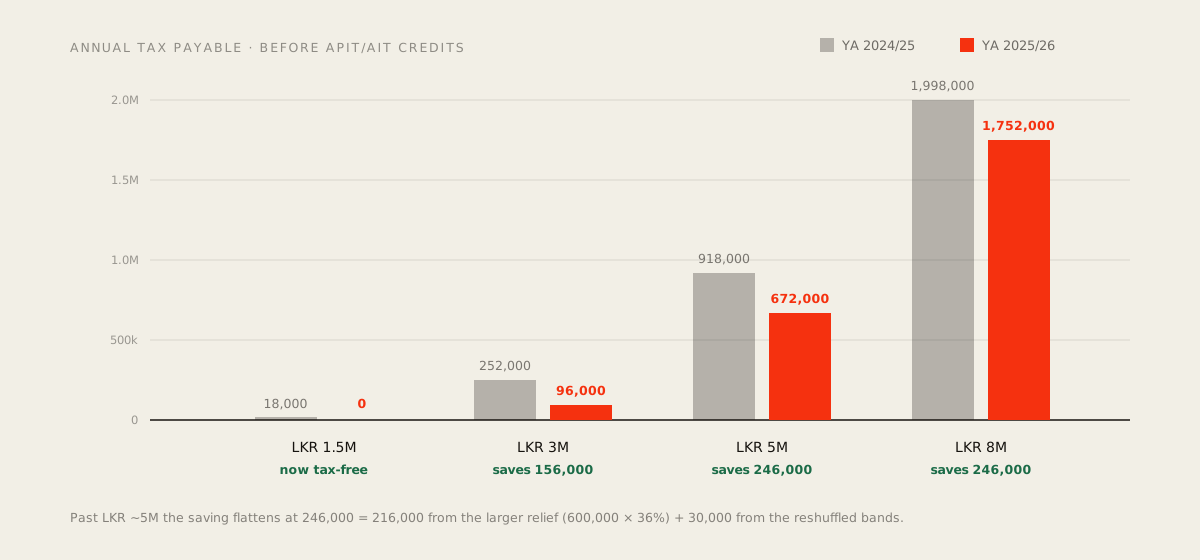
On LKR 3,000,000 of income you now pay LKR 96,000 instead of LKR 252,000. That's LKR 156,000 a year, or about 13,000 a month, that used to go to the IRD and now doesn't.
The relief rose 50% and the 12% band vanished. Two things follow that are worth knowing before you file:
- If you earn under LKR 1.8M, you now owe nothing at all — the whole income sits below the relief line.
- If you earn over about LKR 5M, your saving is fixed at LKR 246,000 and stops growing, no matter how much more you earn. The reason is arithmetic, and it's at the end of this article.
If you last checked your tax position before April 2025, every number you're working from is wrong.
The headline change: relief up, one band gone
The tax-free personal relief rose from LKR 1,200,000 to LKR 1,800,000 a year, a 50% increase, effective 1 April 2025. At the same time, the old six-band structure lost its 12% band entirely, and the width of the first taxable band doubled.
| YA 2024/25 | YA 2025/26 | |
|---|---|---|
| Personal relief | LKR 1,200,000/year | LKR 1,800,000/year |
| Band 1 | First 500,000 @ 6% | First 1,000,000 @ 6% |
| Band 2 | Next 500,000 @ 12% | Next 500,000 @ 18% |
| Band 3 | Next 500,000 @ 18% | Next 500,000 @ 24% |
| Band 4 | Next 500,000 @ 24% | Next 500,000 @ 30% |
| Band 5 | Next 500,000 @ 30% | Balance @ 36% |
| Band 6 | Balance @ 36% | N/A |
Sources: TaxCalculator.lk, "New Sri Lanka Income Tax Rates 2025/2026 Explained"; TaxCalculator.lk, "A Beginner's Guide to Income Tax in Sri Lanka: 2026 Edition".
Two things worth noticing in that table. First, the 12% band is simply gone, so income that used to be taxed at 12% now either falls inside the wider 6% band or jumps straight to 18%. Second, the top 36% rate now starts sooner in absolute terms relative to income above relief, but the much bigger relief threshold more than compensates for most earners.
What it means in rupees: three examples
Numbers explain this better than percentages. Here's total tax payable (before any APIT/AIT credits) at three levels of total annual income, computed by walking each year's bands in order.
| Total annual income | Tax under YA 2024/25 rules | Tax under YA 2025/26 rules | Annual saving |
|---|---|---|---|
| LKR 1,500,000 | LKR 18,000 | LKR 0 | LKR 18,000 |
| LKR 3,000,000 | LKR 252,000 | LKR 96,000 | LKR 156,000 |
| LKR 5,000,000 | LKR 918,000 | LKR 672,000 | LKR 246,000 |
| LKR 8,000,000 | LKR 1,998,000 | LKR 1,752,000 | LKR 246,000 |
At LKR 1.5M, someone who owed tax under the old relief threshold now owes nothing, because their whole income sits below the new LKR 1.8M line. At LKR 3M, the saving is LKR 156,000 a year, or roughly LKR 13,000 a month back in take-home pay.
Past roughly LKR 5M the saving stops growing and settles at exactly LKR 246,000, which decomposes cleanly into two parts:
- LKR 216,000 from the bigger relief. Once you're in the top bracket, the extra 600,000 of tax-free income is worth 600,000 × 36%.
- LKR 30,000 from the reshuffled bands. The old ladder charged 450,000 on the first 2.5M above relief (500k slices at 6/12/18/24/30%); the new one charges 420,000 (1M at 6%, then 500k slices at 18/24/30%).
216,000 + 30,000 = 246,000. It's a fixed rupee amount rather than a percentage, which is why it looks generous at LKR 5M and negligible at LKR 50M.
These are illustrative calculations based on the published band structures and don't include APIT already withheld, AIT credits, or foreign-service treatment, so your actual payable figure will differ. This is general information, not a substitute for your own return.
Why "12% eliminated" undersells it
Headlines that say "the 12% bracket was removed" make it sound like a narrow technical change. In practice, combined with the relief increase, it means:
- Anyone earning under LKR 1.8M annually now pays zero income tax, versus LKR 1.2M before: a full 600,000 more of tax-free room.
- Someone earning around LKR 2.5M–3M annually (a common salaried-professional range) sees roughly a third of their old tax bill disappear.
- The relief increase does more work than the band restructuring for most people in the middle of the income distribution; the band changes matter more the higher your income climbs.
What stayed the same
Not everything moved. The 15% final tax on qualifying foreign-service income (paid in foreign currency, remitted through the banking system) is unchanged across both years, and APIT/AIT remain credits against the final bill exactly as before, since they don't change how the bands themselves are calculated. (Source: TaxCalculator.lk, "New Sri Lanka Income Tax Rates 2025/2026 Explained".)
Why this matters for last year's assumptions
If you built a budget, a savings plan, or a mental model of "roughly how much tax I pay" before April 2025, it's now wrong: not by a rounding error, but by tens or hundreds of thousands of rupees a year for most salaried earners. That's real money that should be flowing into savings, debt payoff, or investment instead of sitting in an outdated estimate.
This is exactly why Salli's tax engine is versioned by year rather than hardcoded once: the YA 2025/26 pack applies these exact bands, and when the next Budget changes them again, last year's return recomputes under last year's rules while this year's uses the current ones, and no manual re-checking is required.
Sources
- New Sri Lanka Income Tax Rates 2025/2026 Explained (TaxCalculator.lk)
- A Beginner's Guide to Income Tax in Sri Lanka: 2026 Edition (TaxCalculator.lk)
- Sri Lanka APIT Calculator 2025/26 (induwara.lk)
- CMA Sri Lanka: Tax Rate Year of Assessment 2024/2025 (PDF)
Band figures and worked examples in this article are based on publicly published rate tables current as of publication. Always verify your own computation against the IRD's published rate chart or a licensed tax practitioner.