You already know the headline: foreign-currency income remitted through a bank is taxed at 15%. Every freelancer in Colombo has heard it. Here is the part almost nobody has worked out.
It is a maximum rate, not a flat rate. So if your foreign-service income is LKR 3,000,000, the ordinary progressive bands charge you LKR 96,000 — while 15% of the same income would be 450,000. The concession does nothing for you. It only begins to bite at a very specific number:
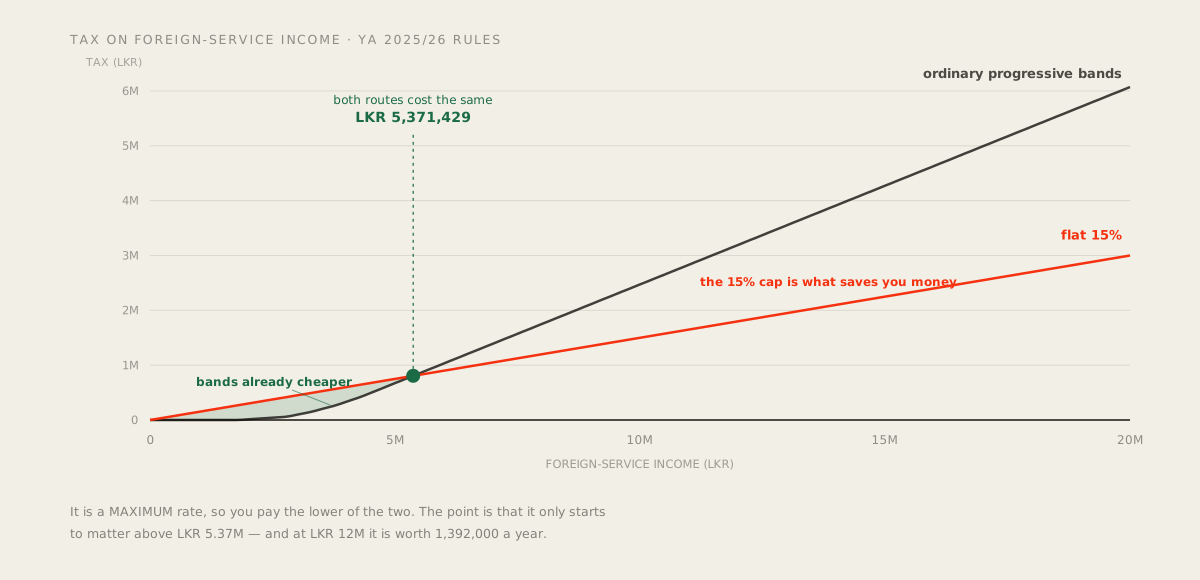
LKR 5,371,429. Below that, the bands already cost you less than 15% and the concession is irrelevant. Above it, the 15% ceiling is worth real money and the gap widens fast — at LKR 12,000,000 of foreign-service income it saves you LKR 1,392,000 a year.
That single number changes what you should be doing. If you earn under about 5.4M from foreign clients, chasing the concession is not where your tax saving is — your reliefs and credits are. If you earn over it, the remittance mechanics below are worth more to you than any other tax decision you will make this year.
For context on scale: worker remittances into Sri Lanka hit a record USD 8.076 billion in 2025, up 22.8% year on year, and official IT/BPM export figures (USD 1.65 billion in 2025) understate the real picture, because a growing freelance community gets paid through personal remittance channels that never show up in export statistics.
The concession: 15%, but only if you remit through a bank
Since 1 April 2025, under the Inland Revenue (Amendment) Act No. 2 of 2025, a specific category of income qualifies for a concessionary maximum 15% tax rate instead of the ordinary progressive bands. The Act's own wording is precise about what qualifies:
"The gains and profits earned or derived from any service rendered in or outside Sri Lanka to any person to be utilized outside Sri Lanka, where the payment for such services is received in foreign currency and remitted through a bank to Sri Lanka."
Two conditions, both required: the service is rendered to someone outside Sri Lanka (or the benefit is used outside Sri Lanka), and the payment is received in foreign currency and remitted through a Sri Lankan bank. Miss either one and the concession doesn't apply.
What happens if you don't remit through a bank
This is where the concession quietly disappears. If the same foreign-service income isn't remitted through the banking system (paid into a foreign account you never bring home, received via a payment method that doesn't route through a licensed bank, or simply not tracked properly), it falls back to being taxed under the ordinary progressive bands, which top out at 36%.
How much that costs depends entirely on how much you earn, which is the part the "15% rule" shorthand hides. Below LKR 5.37M it costs you nothing, because the bands were the cheaper route anyway. Above it, the cost of failing the remittance test is exactly the gap in the chart above — and it grows with every rupee you earn.
| Qualifies for 15% concession | Doesn't qualify | |
|---|---|---|
| Condition | Foreign currency, remitted through a Sri Lankan bank | Not remitted through a bank, or service used within Sri Lanka |
| Tax treatment | Maximum 15% | Ordinary progressive bands, up to 36% |
| Where it's set out | Inland Revenue (Amendment) Act No. 2 of 2025, First Schedule | Standard Inland Revenue Act bands |
Source: Inland Revenue (Amendment) Act No. 2 of 2025, Parliament of Sri Lanka; IRD Notice to Taxpayers PN/IT/2025-01.
Foreign tax credits: relief for tax already paid overseas, with a real cap
If a platform or client withholds tax in their own country before paying you, Sri Lanka doesn't tax that same income again from scratch. Section 80 of the Inland Revenue Act No. 24 of 2017 lets a resident individual claim a foreign tax credit for foreign income tax already paid on their assessable foreign income.
But the credit isn't unlimited. Section 81(1)(b) caps it at the Sri Lankan tax that would otherwise be payable on that same income. Two practical outcomes follow directly from that cap:
- If the foreign tax you paid is less than your Sri Lankan liability on that income, you pay the difference to the IRD. The credit doesn't wipe the bill out; it just prevents double taxation up to what Sri Lanka would have charged.
- If the foreign tax you paid is more than your Sri Lankan liability, Section 81(3) is explicit that the excess is not refunded, and cannot be carried back or carried forward to another year. It's simply lost.
That second point catches people by surprise more than the first, because there's no "banking" a foreign tax credit for later use. Whatever isn't used against this year's Sri Lankan liability on this year's foreign income doesn't survive past this year's return.
The mistakes that cost people the most
Three, in the order they cost the most:
- Assuming 15% is always the better deal. Below LKR 5.37M it isn't, and someone who declares foreign-service income at a flat 15% without checking the bands can hand the IRD more than it asked for.
- Failing the remittance test above the breakeven. Money left in a Payoneer or Wise balance, or paid into an account abroad you never bring home, doesn't meet the "remitted through a bank" condition — and above 5.37M that is where the real money is lost.
- Not documenting foreign tax paid, which makes a Section 80 credit hard to substantiate at all.
All three are the same underlying problem: the answer depends on your actual numbers, and you can't eyeball it.
Work out your own breakeven
The number in this article, LKR 5,371,429, is where the two routes cost the same for foreign-service income alone. Yours moves as soon as you have salary, rent, or interest alongside it, because those fill the lower bands first and push your foreign income into higher ones.
That is exactly the calculation Salli does from your posted ledger: it computes both routes on your real income mix, applies the one that legitimately costs less, and tracks foreign tax paid so a Section 80 credit isn't missed. The engine is deterministic — the AI never touches the arithmetic — and filing for YA 2025/26 is open now and closes 30 November 2026.
Sources
- Inland Revenue (Amendment) Act No. 2 of 2025, Parliament of Sri Lanka (official gazette bill text)
- IRD Notice to Taxpayers PN/IT/2025-01, 26 March 2025
- Inland Revenue Act No. 24 of 2017, Sections 80–81, Inland Revenue Department
- Central Bank of Sri Lanka, Workers' Remittances Statistics
- EconomyNext: "Sri Lanka's IT, BPO export revenue lower than reality after crisis: expert" (8 Feb 2026)
Rates, thresholds, and statutory references are current as of publication and can change, so always confirm with the IRD or a qualified tax practitioner before relying on a figure for your own filing.